
How Complementary Forest Finance Mechanisms Can Promote Tropical Forest Protection
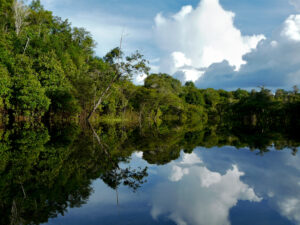
The Tropical Forests Forever Facility (TFFF) and Jurisdictional REDD+ (JREDD+) can work hand-in-hand to conserve tropical forests, reduce GHG emissions, and help close more than half of the annual financing gap needed to conserve tropical forests and reduce their loss, according to new analysis.
The paper – by André Aquino, head of the Special Advisory on Economy and Environment at Brazil’s Ministry of Environment and Climate Change, and Andres Espejo, an international forest climate finance expert – calls for governments, investors, and multilateral institutions to scale up investment in these two mechanisms as countries gear up to scale up efforts to promote forest conservation in the lead-up to COP30 in Belém.
Tropical forests are the planet’s “green infrastructure,” regulating climate and rainfall, providing habitat for millions of species, and sustaining livelihoods. Yet the world continues to lose them at alarming rates, largely because conservation cannot compete financially with more profitable land uses. Meeting the enormous financial needs for forest protection will require multiple complementary solutions.
Two Solutions, One Shared Goal
The TFFF, first proposed by the Government of Brazil at COP28, is a new financing mechanism designed to provide long-term, continuous payments for hectares of standing tropical forests. The TFFF seeks to reward low-deforestation countries for maintaining their forest cover. JREDD+, meanwhile, pays for verified reductions in greenhouse gas emissions through reduction in deforestation and forest degradation, and forest restoration. JREDD+ is particularly effective in jurisdictions with high historical deforestation, where emissions reductions can be measured and credited.
“TFFF and JREDD+ are complementary,” the authors write. “By working together, they can expand the pool of available finance so that tropical forest countries can have the resources needed to protect forests. The two financing mechanisms target different forest activities and tap into different financing streams —helping to close implementation gaps and ensuring lasting protection of the world’s tropical forests. Hence, there is no double counting or double payment across these mechanisms”
Closing the Forest Finance Gap
According to forthcoming analysis from the UN Environment Programme that is cited in the paper, by 2030 around USD 15.8 billion per year will be needed to protect tropical forests (maintain forest cover and reduce deforestation). The TFFF alone could mobilize USD 4 billion annually, while JREDD+ could generate up to USD 4.5 billion. Together, these mechanisms could provide more than half of the funding required to meet the finance needs for tropical forest protection.
Built on Strong Foundations
Both mechanisms build on the institutional progress made over the past decade. JREDD+ has advanced national forest monitoring systems, safeguards, and benefit-sharing mechanisms that can also serve as a foundation for TFFF implementation. Crucially, TFFF requires that at least 20% of funds flow directly to Indigenous Peoples and Local Communities (IPLCs), recognizing their critical role in forest stewardship.
Looking to COP30
As countries prepare for COP30 in Belém, the paper underscores that scaling up both TFFF and JREDD+ will be critical to building a more resilient global forest finance system. By mobilizing around these complementary mechanisms, governments, investors and companies have a unique opportunity to demonstrate real progress on closing the tropical forest finance gap, support Indigenous Peoples and local communities, and set a new benchmark for both short-term and action, and long-term conservation finance.






Please see our Reprint Guidelines for details on republishing our articles.